
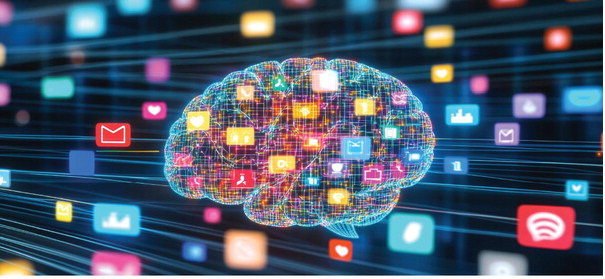
Social media can be a great thing. Platforms like Instagram, TikTok, Snapchat, X, and LinkedIn help us stay in touch, share ideas, grow our professional networks, and feel connected—whether you’re sending a meme to a friend, jumping into a viral trend, watching your cousin’s wedding reel from thousands of miles away, or posting about a promotion.
But social media can also mess with our heads.
These apps are designed to keep us scrolling. And while they offer entertainment, information, and connection, growing research suggests they may also be rewiring our brains in ways that leave us more anxious, distracted, and emotionally disconnected than ever.
HOW SOCIAL MEDIA AFFECTS THE BRAIN
Every like, share, or comment gives the brain a hit of dopamine—the feelgood chemical that signals pleasure and reward. It’s a form of instant gratification that can become addictive. Over time, those quick hits make it harder to focus, unwind, or even enjoy slower, offline moments. A 2023 Pew study found that 46% of U.S. teens say they’re “almost constantly” online.
That nonstop stimulation can be especially harmful for teens and young adults, whose brains are still developing. According to the CDC, suicide rates among people ages 10 to 24 rose by 60% between 2007 and 2021. Many experts connect that rise to the mental health impact of social media.
When you’re constantly seeing curated, filtered images of “perfect” lives, it can create unrealistic expectations, loneliness, and feelings of exclusion. Even LinkedIn, with all its polished career wins and updates, can drive a sense of “compare and despair.”
ARE SOCIAL SKILLS AT RISK?
Yes. While social media keeps us digitally connected, it often replaces real-world interaction. As face-to-face time decreases, so do important social skills like empathy, listening, and conflict resolution.
A study published in Computers in Human Behavior found that people who spend more time on
social media often felt less emotionally supported and alone.
HOW TO BE HEALTHIER ONLINE
If you ever feel like social media is draining you, know that you’re not alone. Here are a few tips to take back control:
• Set time limits. Start by trimming your screen time by 30 minutes each day.
• Curate your feed. Follow people and content that make you feel good.
• Create screen-free zones. Skip phones at dinner or before bed.
• Pause before scrolling. Ask yourself: “Why am I opening this?”
• Lead by example. Try a phone fast, and show others that life happens offline too.
• Reconnect in person. Texting is fine, but real conversation is better!
FINAL THOUGHTS
Social media isn’t the enemy. But if we’re not paying attention, it can quietly shape our thoughts, habits, and relationships in ways we don’t even notice. Stay aware, set boundaries, and keep showing up in the real world.
Social media should work for us, not against us, to help keep our connections sharp and healthy.