


WAITING UNTIL 70 FOR SOCIAL SECURITY CAN BOOST YOUR CHECKS BY 24%
For people of a certain age, it’s the age-old dilemma: At what age should you begin collecting Social Security?
The short answer is — it depends.
U.S longevity impacts Social Security
People are living longer than in prior generations. Today, the average life expectancy for those who reach 65 is 82 for men and 85 years for women, according to the AARP.
When the Social Security Act was passed in 1935, life expectancy at birth was about 60 for men and 64 for women. At that time, the retirement age of 65 was higher than the average life expectancy.
Due to concerns about long-term solvency, the government began gradually upping its full retirement age in 1983. Currently, the retirement age is 67 for people born in 1960 and after.
That brings us to another com- mon concern. “Clients always ask me, ‘Should I go ahead and take my Social Security now because it’s about to run out of money?’,” said Evelyn Zohlen, senior financial planner at Apella Wealth in Huntington Beach.”
“Changes to Social Security will assuredly come, but not for people above the age of 55 who count on it and don’t have time to pivot. Lawmakers want to be reelected.”
You have the option of collecting Social Security beginning at 62, known as “early retirement age.” Try not to.
If you take Social Security at 62, your monthly payments will be permanently about 30% smaller than if you wait until the full retirement age of 67.
Furthermore, if you want to keep working and you make more than the current yearly earnings limit of $23,400, your benefits will be taxed at a considerably higher rate.
However, beginning the month you reach full retirement age, your benefits will no longer be reduced based on other income, no matter how much you earn.
Schwab.com recommends: “If you’re still working, you may want to postpone Social Security either until you reach your full retirement age or until your earned income is less than the annual limit.”
Fortunately, there’s some flexibility. If you start taking payments at full retirement age, you can voluntarily stop at any point to allow your future checks to increase — until age 70.
Let’s say you elect to receive early benefits at age 62 but return to work after a few months and prefer to delay. Within the first 12 months, you can reset your decision by withdrawing your application and repaying any benefits received.
Delaying retirement increases your benefit
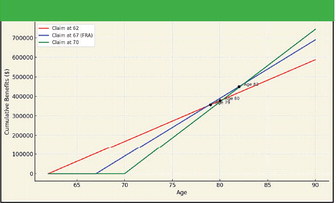
“If your full retirement age is around 67 and you wait until 70, your benefit will increase by 8% each year. That’s a total of 24% plus costof- living adjustments in just three years—for the rest of your life,” said Zohlen.
“Where else can you get a guaranteed annual 8% increase three years in a row? I would never promise my clients that from other investments.”
It’s important to note that applying after age 70 will not increase your benefit.
Everyone’s situation is different. “It’s impossible to make sweeping generalities,” Zohlen said.
Perhaps you are married. The higher wage earner — who would receive the larger monthly benefit — might delay until 70, while the other spouse starts earlier. After one spouse dies, the survivor is eligible for only one benefit, typically the larger one.
Or perhaps you can no longer work due to health issues and you struggle financially. In that case, taking Social Security as soon as possible may offer your only steady source of income.
Some individuals with chronic illness may choose to enjoy their benefits earlier, while they still can.
Bottom line: Do what’s best for you.
You’ll break even at age 82
Consider that you’ll likely break even around age 82 for the benefits you gave up by delaying until age 70. In general, betting that either you or your spouse will live longer than 82 is a safe assumption.
“It all comes down to answering the question, ‘When are you going to die?’” Zohlen said. “I’m being a little tongue-in-cheek. But ask yourself, do you have longevity in your family? Are your mom and dad and great Aunt Tilly still alive and kicking in their late nineties?”
We might assume that the older we are, the less money we’ll spend. But often, the opposite is true.
“The longer you live, the more expensive it is--with added necessities like long-term care,” Zohlen said. “Bigger Social Security checks later in retirement help alleviate financial pressures.”