
As September rolls around, high school seniors face two new realities: the start of their final high school year – and the beginning of college applications.
The transition from high school to post-secondary comes with familiar questions: “Where do you want to go to school? What’s your major? What will you do after?”
For students pursuing further education, the coming months bring a stream of deadlines, with each college application carrying different requirements. While paper forms and mailed admissions packages have been replaced with online submissions and acceptance letters with virtual confetti, the digital shift brings both new complexity and broader academic opportunities.
COMMUNITY COLLEGE
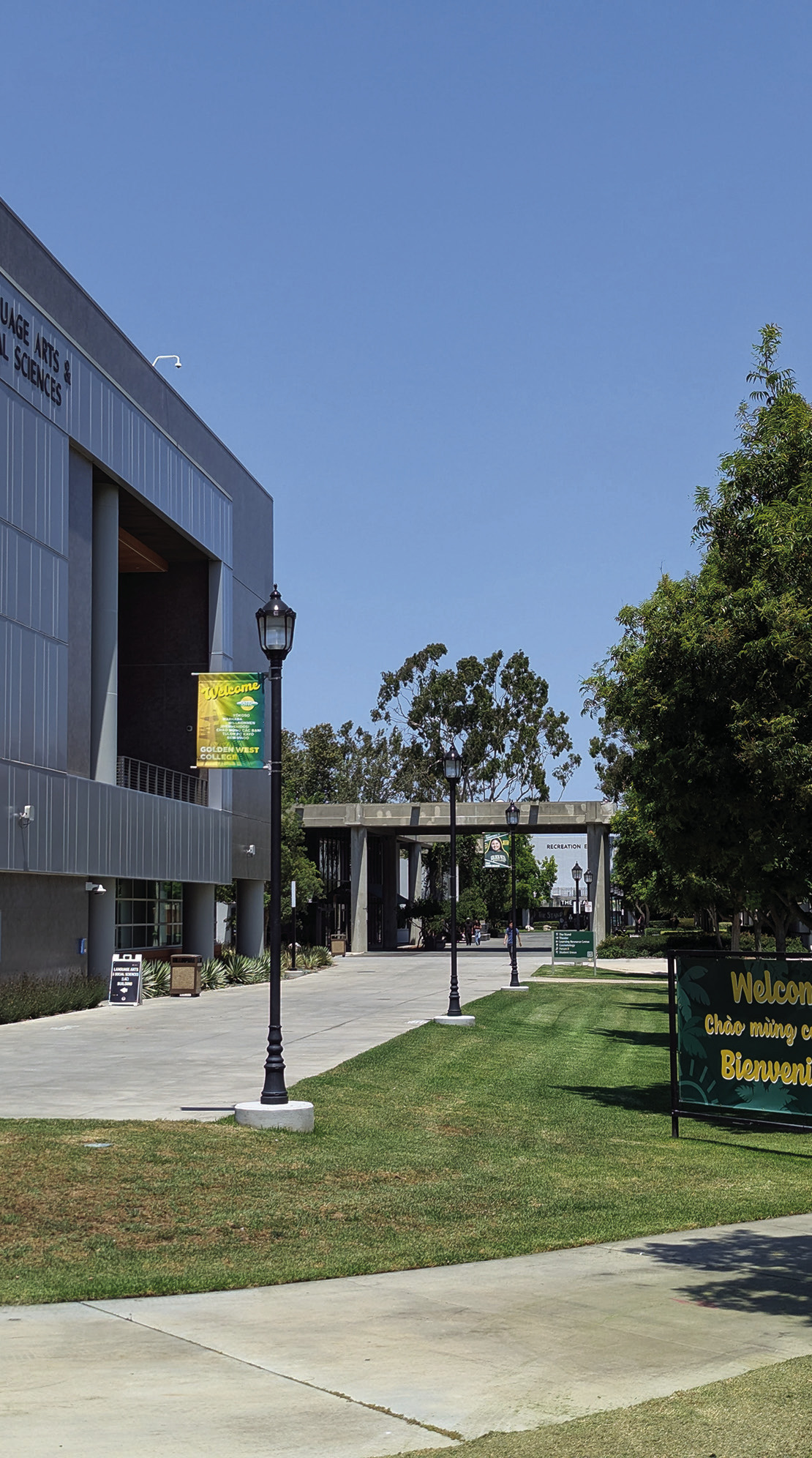
Over 2.1 million students attend 116 community colleges in California, and students can easily apply online. Local options include Orange Coast, Golden West and Coastline colleges.
Financially eligible California residents can apply for the California College Promise Grant, which waives $46/unit enrollment fee for their first two years. Some colleges offer California Promise programs, covering enrollment fees for two years regardless of financial status. Examples include OCC’s Pirate Promise and GWC’s Golden Promise, each with specific program requirements.
Students may transfer to fouryear institutions such as University of California and California State University campuses. Those who meet certain requirements and complete designated coursework may qualify for the Transfer Admission Guarantee program, which offers a guaranteed spot at participating UC campuses.
Certificate programs in areas such as technology and business are also available. Pathways include woodworking, emergency medical response, welding, nursing and aviation. For a full list of available degree and certificate programs, visit each college’s academic offerings page.
CALIFORNIA STATE UNIVERSITIES (CSU)
The California State University system includes 23 campuses. Applications are submitted via the CSU application. CSUs aim to provide educational opportunities to those with limited resources and to help prepare California’s future workforce. The system produces the most bachelor’s degrees in the state — more than 125,000 annually. Nearly onethird of CSU students are the first in their families to attend college.
The three Polytechnic CSU schools — in San Luis Obispo, Pomona and Humboldt — emphasize hands-on learning, primarily in STEM fields. Cal State Long Beach and Cal State Fullerton provide local admission preference for students who meet requirements and attend Huntington Beach Union High School District schools.
The CSU application asks students for their academic history, extracurriculars, work, and college prep program participation. Standardized test scores, recommendation letters, and personal essays are not required or considered.
To apply, students must complete the A-G requirements: a set of 15 courses in history, English, math, science, foreign language, visual or performing arts and an elective. A GPA of at least 2.50 is required.
Applications for Fall 2026 admission open Oct. 1 and close Dec. 1. There is a fee of $70 per campus, with fee waivers available to eligible students.
UNIVERSITY OF CALIFORNIA (UC)
There are nine undergraduate UC campuses, known for their research focus. Collectively, the UC system includes six academic health centers, three Department of Energy national laboratories and five comprehensive cancer centers.
The UC application includes educational history, activities and responses to four Personal Insight Questions (PIQs), each limited to 350 words. These questions touch on topics such as leadership, community service, talent and creativity.
UC campuses do not consider standardized test scores or recommendation letters in admissions decisions. Each campus reviews applications independently.
Applicants must complete the A-G requirements with a GPA of at least 3.0 and no grades below a C. Applications opened Aug. 1 and can be submitted between Oct. 1 and Dec. 1. The application fee is $80 per campus, with fee waivers available.
OUT-OF-STATE AND PRIVATE UNIVERSITIES
Students applying to out-of-state, private or international colleges will most likely use the Common App, which allows students to apply to up to 20 of more than 1,100 participating colleges through a single application.
Each college has its own deadlines and requirements. Some offer early action, early decision and regular decision options. Early action and early decision both provide earlier admission decisions, but early decision is binding — students who are accepted must attend.
Many colleges require one or two academic recommendation letters. In addition to the 650-word main personal essay, students may needs to write shorter, school-specific supplemental letters. These may range from serious to creative — for example, writing a letter to a future roommate — and students can often submit optional materials such as art portfolios.
After the COVID-19 pandemic, some schools have reinstated standardized testing requirements. The most common exams are the SAT, which covers math, reading and writing, and the ACT, which includes a science section.
FINAL ADVICE
College applications allow students to present their personality, values and goals. Every section of the application contributes to a narrative about how they spend their time and why it matters to them.
Applications are considered in context, with many colleges taking a holistic approach that weighs a student’s experiences, background and opportunities.
Financial aid is another crucial step. Students must complete the Free Application for Federal Student Aid (FAFSA) to receive financial aid offers. Some colleges may also require the CSS Profile, available through the college board. Students should check each college’s financial aid requirements.
Importantly, college is just one option. Depending on a student’s goals and circumstances, paths such as vocational training, the military or joining the workforce may be equally valid. Students are encouraged to speak with school counselors to explore all available options.