
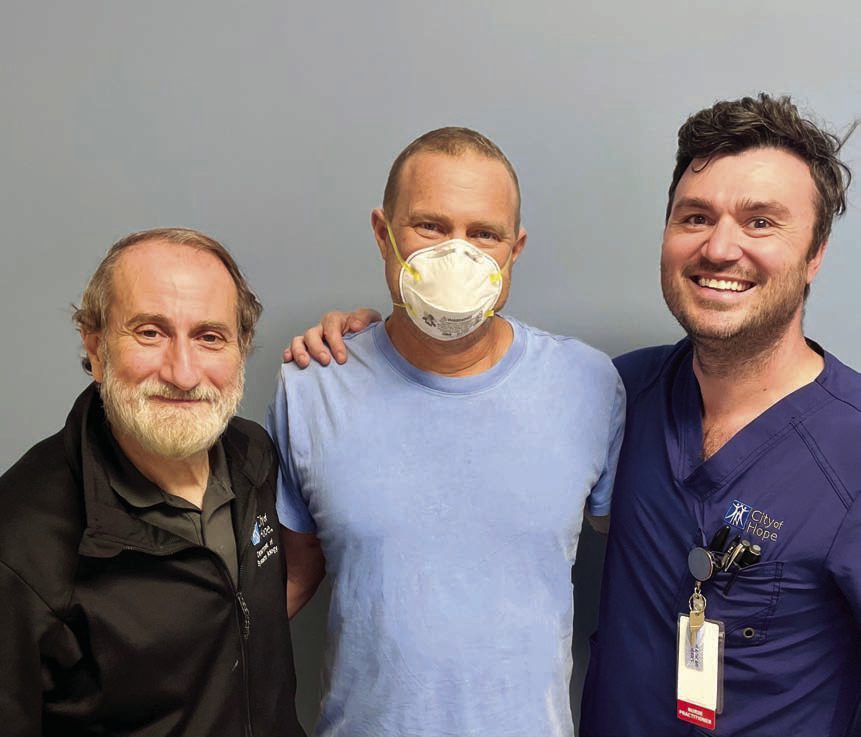
Despite experiencing constant fatigue, Reeve Hartman kept going to work—right up u ntil he was diagnosed last March with acute myeloid leukemia (AML). The very next morning, Reeve began chemotherapy at City of Hope hospital in Duarte.
“It’s so weird,” he said. “One day you’re just living your life and the next you’re loaded up on chemo.”
Reeve and his wife, Alison, raised five children, ages 14 through 22, in Huntington Beach. He has taught world history at South Lake Middle School in Irvine for 29 years.
Reeve initially shrugged off his uncharacteristic headaches. But when he awoke from a nap with labored breathing, Alison drove him to a local emergency room. Staff there found nothing too alarming.
After looking over her husband’s bloodwork, Alison—who worked in a pathology lab before children came along—was not convinced. She made an appointment with a hematologist, who confirmed her suspicions of leukemia.
That night, Reeve told his youngest children about his illness face-toface and Zoomed with his two kids away at college.
“It was almost like I was apologizing,” he recalled, choking up. “I felt terrible that I had to be gone, even though it wasn’t my fault.”
Thus began his first in a series of long hospitalizations—the first one, for 29 days.
When chemo took Hartman’s hair, son Owen, a junior at Marina High, shaved his head in solidarity. Hartman’s students delivered best wishes on a roll of butcherblock-paper that wrapped around his hospital room.
Dr. Guido Marcucci, a leading expert in AML, has been at the family’s side throughout. “Dr. Guido (his nickname) is so personable and knowledgeable,” Alison Hartman said. “He is just phenomenal.”
Marcucci described AML’s defective cancer cells as “queen bees that give rise to worker bees.” The malignant invaders destroy healthy blood cells that fight infection and carry oxygen.
“We first need to kill not just the worker bees but, critically, the queen bees with chemotherapy,” he said.
Then, in a stem cell transplant, the patient receives new bone marrow from a donor. “Bone marrow is an organ like any other organ, but a liquid organ,” Marcucci explained.
Fortuitously, Hartman’s younger brother Tanner proved a perfect match. “Being a donor is a huge ordeal, but Tanner agreed without hesitation,” Hartman said. “I am forever grateful.”
Hartman underwent the transplant in July. With his immune system initially stripped and—follow ing surgery--rebuilding, he isolated for 197 days straight on the hospital’s campus. Now he can go home for brief visits, receiving outpatient care at City of Hope’s regional clinic in Huntington Beach.
“Reeve is doing extremely well,” Marcucci said. “One of the pillars of success is the support of family and friends, and he has a really good support system.”
“I’ve really missed our house, our little dog—all those things you take for granted,” he said. “I love to surf. I can’t wait until I can get my feet back in the sand.”
For now, his goals are set on regaining strength. “Dr. Guido and the entire staff at the City of Hope have been fantastic,” Hartman said. “They are all about beating cancer.”
Scan the QR to support Reeve’s recovery: